Home » Blog » Safely and productively introduce enterprise AI
Reading time: 16 minutes
Artificial Intelligence
Artificial intelligence (AI) has long been a part of everyday work in many companies. Employees use AI to structure texts, summarize information, develop ideas, or complete recurring tasks more quickly. However, this use often doesn't begin with a company-wide strategy. It arises decentrally, from a specific need, and sometimes through private access to publicly available AI applications.
At INSIRE, we understand the use of generative AI not merely as the introduction of individual tools, but as part of a comprehensive AI strategy: We want to unlock potential where AI creates tangible added value in everyday work – securely, responsibly, and practically. In accounting, we explore potential use cases in finance processes, for example, in conjunction with SAP Joule and other AI tools. In client projects and internal collaborations, our internal AI platform, which we will discuss below, supports our employees in working more efficiently and using knowledge more effectively. Crucially, this involves combining innovation with the requirements of a professional business environment: As soon as customer information, internal documents, or confidential knowledge come into play, security, data protection, and clear guidelines must be considered alongside functionality.
Where is entered data processed? In which region is it stored? Is the content used for training models? What data are employees even allowed to enter? How can the requirements of data protection (GDPR), information security, and the EU AI Act be met? And who is responsible for rules, approvals, and the further development of its use?
For us, it was therefore clear: We didn't want to ban AI or make access unnecessarily difficult. We wanted to create a secure and centralized framework in which our employees could use the technology productively.
Between productivity and responsibility
The use of generative AI puts companies in a difficult position. On the one hand, there are efficiency, productivity, and a noticeable reduction in repetitive tasks. On the other hand, there are data protection, information security, governance, and the question of how to integrate a new technology into existing processes in a controlled manner. A complete ban on private AI applications usually does not resolve this tension. If employees have already experienced the tangible benefits, there is a risk that they will still use unauthorized solutions. This creates so-called shadow use, which poses a significant risk to companies, is barely visible, and difficult to control.
At the same time, simply providing a new platform is not enough. Without understandable guidelines, clear responsibilities, and concrete use cases, usage will either remain low or develop in an uncoordinated manner once again.
Our goal was therefore twofold. We wanted to reduce risks while simultaneously unlocking the potential of AI in a targeted manner. To achieve this, we needed an approach that combined technical, organizational, and human aspects.
Why the pressure to act is growing
The pressure to act is not only due to new technological possibilities. The use of AI is growing faster than the organizational and legal frameworks of many companies.
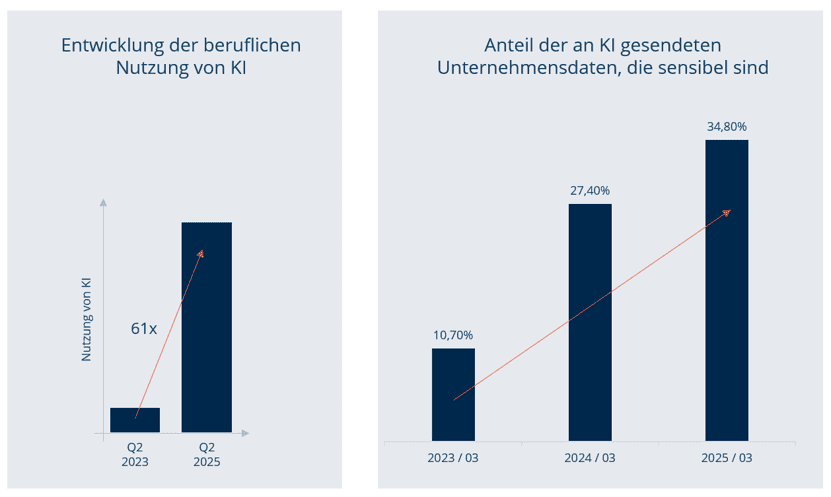
The Cyberhaven AI Adoption and Risk Report 2025 illustrates the scale of this development. According to the report, the frequency of professional AI use increased 4,6-fold within twelve months and 61-fold within two years. Simultaneously, the proportion of sensitive corporate data among the data input into AI applications rose from 10,7 percent to 34,8 percent. Furthermore, 83,8 percent of the analyzed corporate data flowed into applications that Cyberhaven classified as medium, high, or critical risk. The study is based on usage patterns of approximately seven million employees. [^1]
These figures do not mean that every third use of AI is automatically illegal. However, they do show how quickly productivity gains can clash with data protection, information security, contractual risks, and intellectual property protection when there is no approved corporate framework.
Professional AI use and data risk: Visualization of the development from 2023 to 2025 with three key figures: 61-fold increase in usage in two years, increase in the proportion of sensitive data from 10,7 to 34,8 percent, and 83,8 percent data flow to tools classified as at least medium risk.
An example from Samsung illustrates the risk. Shortly after employees were allowed to use ChatGPT for their work, the company identified at least three instances within a few weeks in which confidential information had been transmitted to the external service. These included faulty source code for error analysis, program code for optimizing audit processes, and the transcript of an internal meeting for creating a meeting minutes document. How Samsung technically detected these individual entries was not publicly explained. [^2]
The problem was that this meant protected know-how left the controlled corporate environment and was processed on external servers. Samsung pointed out that transmitted data could only be recalled or completely deleted with great difficulty. This created risks to trade secrets, intellectual property, and contractual confidentiality. Samsung initially limited the size of inputs and subsequently restricted the use of generative AI to company devices and internal networks. This case illustrates what can happen when a useful tool is adopted in daily work faster than rules, technical safeguards, and an approved alternative. [^2]
Our initial focus wasn't on selecting a specific tool. First, we considered the requirements arising from our daily work and where generative AI could provide concrete benefits.
Several topics were the focus:
Data protection and data processing
We needed to be able to understand how input and uploaded content are processed. This included, in particular, questions about data residency, potential training purposes, and the handling of confidential information. A technical solution must be integrated into the respective company's data protection concept. It does not replace the legal assessment or the definition of permissible usage scenarios.
Central and controlled access
Instead of numerous individual private licenses, we wanted to provide a shared enterprise solution. Employees should be able to work with AI via a shared access point. At the same time, the company should be able to control the deployment of roles, models, and usage options.
Practical applications
The implementation shouldn't stop at general experimentation. Company knowledge should be securely leveraged with AI and accessible where it already resides. Integrations with systems like SharePoint, Confluence, Jira, or Excel allow for the direct incorporation of existing information. This simplifies research, summarizes extensive content, and supports text drafting or internal inquiries. For us, the real added value arises when AI isn't a standalone solution, but rather meaningfully integrated with existing knowledge sources and workflows.
Exchange and reusability
Good solutions shouldn't remain hidden within individual teams or personal networks. Our goal was to share and further develop experiences, instructions, and the assistants we created within the company. In this way, a shared body of knowledge gradually emerges from individual experiments.
Easy to use
A platform is only effective if employees actually use it. Therefore, in addition to security and controllability, user-friendliness was crucial. Access to AI should be as easy as possible and geared towards real-world tasks.
From requirements to tool selection
After defining our requirements, we didn't just compare individual language models. We compared different deployment models and enterprise platforms. Depending on the point in time, these included ChatGPT in various pricing plans, Claude, Google Gemini, Microsoft 365 Copilot, MeinGPT, Notion AI, and Langdock.
Such a comparison is more complex than simply comparing feature lists. A language model, an assistant integrated into an office suite, and a model-agnostic enterprise platform solve different problems. Therefore, we first categorized the solutions and then evaluated them against a common target vision.
Our assessment framework
ESG/SRI
Guiding questions
Licensing and scaling
Which licensing model applies? Are there minimum purchase requirements or minimum number of users? What are the costs for, for example, 25 users? Which features are only available in higher-priced plans?
Models and flexibility (model agnosticism)
Which leading models are available? Can the company switch models or is it bound to one supplier long-term?
Data protection and contracts
Is there a legally sound data processing agreement (DPA) in place? Is customer data used for training purposes, or is there a contractually secured training opt-out? Which subcontractors are involved?
Data residency and processing
Where is the stored data located? Where does the actual model processing, i.e., the inference, take place? Are prompts, files, metadata, logs, backups, or support data processed outside the European Economic Area?
Safety
How is data encrypted during transmission and at rest? What roles, access controls, protocols, deletion concepts, and administration options are available?
Identities and keys
Can single sign-on and role-based access control be integrated? Are customer-managed keys, bring your own key, or other forms of customer-side key control offered? Can access be revoked centrally?
Protection of sensitive data
Are there ways to detect, pseudonymize, or mask personally identifiable information (PII) before content is passed on to a model?
Integration
How well does the solution integrate into the existing technology stack? Are there connectors to SharePoint or other knowledge resources and enterprise applications?
Range of uses
Are text summarization, research, file interaction, code, images, assistants, agents, workflows, and APIs supported?
Governance and Operations
Can released agents, policies, model access, and usage options be centrally managed and further developed?
Adoption
How low is the barrier to entry? What training opportunities, support, and options exist for internally sharing successful use cases?
Prices, minimum purchase requirements, and product features change rapidly. Therefore, any vendor evaluation should always be documented with the date, current pricing, and sources. Values not confirmed by contract or vendor documentation must be marked as assumptions or estimates. This is especially important for pricing models based on a specific number of users.
EU hosting alone is not enough.
A key aspect of our evaluation was the distinction between data residency and GDPR compliance. A server location within the EU is an important component, but not an automatic proof of compliance.
For a reliable assessment, the entire data flow must be considered. This includes storage, model inference, logging, backups, support access, subcontractors, and potential access from third countries. If personal data is transferred to a recipient outside the European Economic Area, the requirements of Chapter 5 of the GDPR apply. Depending on the circumstances, an adequacy decision or appropriate safeguards are required. According to case law and the recommendations of the European Data Protection Board, it must also be examined on a case-by-case basis whether the law and practices of the recipient country impair the effectiveness of these safeguards. [^3]
In practical terms, this means that the "EU Hosting" label only answers some of the questions. Companies should at least check the following:
Where are prompts, files, and output permanently stored?
Where does the actual inference take place?
What telemetry, protocol, and support data is generated?
Which subcontractors and model providers are involved?
Does a data processing agreement (DPA) exist and does it reflect the actual processing chains?
Is the content used for training, product improvement, or human testing?
What deletion periods and storage options apply?
What transfer mechanisms and additional safeguards exist when dealing with third countries?
What legal basis, purpose limitation, and data minimization apply to the specific use case?
A platform can provide essential technical and contractual prerequisites. However, its compliance with data protection regulations still depends on the specific application, the data processed, and the company's configuration. Therefore, we avoid blanket statements such as "automatically GDPR compliant."
Security consists of several levels
In our technical assessment, we didn't reduce security to the storage location alone. A viable security concept considers several levels:
Encryption during transmission and storage
Data should be protected both during transmission and at rest. Therefore, when evaluating an enterprise AI solution, it is essential to examine which encryption standards are used, which data they apply to, and whether they cover the entire data flow.
For transmission, at least TLS 1.2 in a secure configuration, preferably TLS 1.3, should be used. Outdated SSL and TLS versions as well as insecure cipher suites must be disabled. The BSI describes the requirements for protocol versions and cryptographic methods in Technical Guideline BSI TR 02102 Part 2. [^6]
For stored data, an established encryption method such as AES 256 or a comparably secure method should be used. Protection must cover not only prompts and uploaded files, but also outputs, knowledge bases, logs, temporary data, and backups. AES 128, AES 192, and AES 256 are considered in the current cryptographic recommendations of the BSI (German Federal Office for Information Security), although the specific choice must be appropriate to the protection requirements and the architecture. [^7]
This information should be compared with the current supplier documentation and the specific deployment option in the respective selection process.
Key control
Customer Managed Keys and Bring Your Own Key Companies can be given additional control over encryption keys. This includes not only key ownership and creation, but also rotation, logging, and the ability to centrally revoke access. The availability of such features varies depending on the provider, plan, and architecture, and must be explicitly verified.
PII protection before model processing
Detecting and masking personal information before it is passed to a model can reduce the risk. However, this is not a free pass. The quality and coverage of the detection, misclassifications, remaining metadata, and the handling of unstructured documents must be evaluated. For sensitive use cases, additional organizational pseudonymization before uploading may be necessary.
Client Side Encryption and Zero Knowledge
Client-side encryption encrypts content before it leaves the company's controlled environment. Zero-knowledge architectures aim to prevent the platform provider from accessing unencrypted content. This offers a particularly high level of protection, but it restricts functionality in generative AI as soon as an external model requires plaintext for processing. Therefore, it is crucial to distinguish precisely which data remains encrypted for storage, search, and model inference, and which components can decrypt it. Terms like "zero knowledge" should only be used if the architecture and vendor documentation demonstrate this for the specific data path.
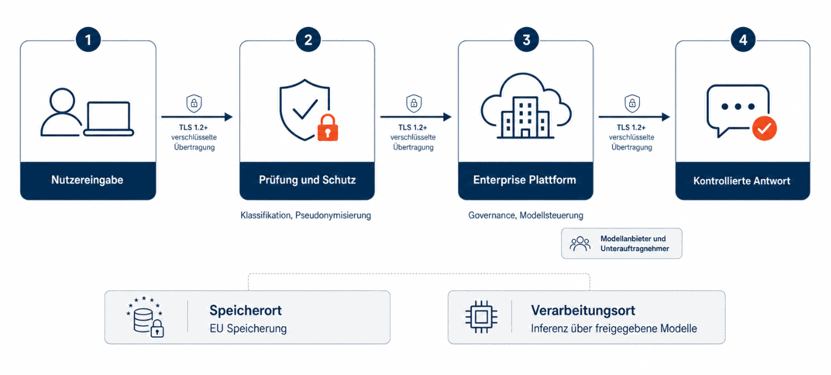
Data flow for secure enterprise AI use:** User input, optional classification and pseudonymization, central enterprise platform, selected model, encrypted transmission, controlled return. Separately mark storage and processing locations. Identify model providers and subcontractors as a separate layer.
What skills should the solution cover?
Choosing a business solution depends on more than just chat functions. Our practical experience has revealed a broader objective:
Draft texts, translations and summaries
Research using verifiable sources
Interaction with files and large documents
Integration of shared knowledge resources, for example SharePoint
Connectors to external enterprise applications
Individual agents with clear instructions and knowledge
Reusable workflows for multi-stage tasks
Model-agnostic access for suitable models per use case
API access for custom applications and automations
Code generation and technical analysis
Image and, if applicable, video generation
Open interfaces and MCP servers for controlled tool connections
Multi-agent approaches for clearly defined, orchestrated subtasks
Not every function needs to be used productively at launch. The crucial point is to distinguish between standard use cases that can be used in the short term, applications to be piloted in a controlled manner, and later development phases.
Source [^1]: Cyberhaven, 2025 AI Adoption and Risk ReportThe publication cites a 4,6-fold increase in usage in twelve months, a 61-fold increase in 24 months, 34,8 percent sensitive data, and 83,8 percent data flow to platforms classified as at least medium risk.
Source [^2]: CNBC, Samsung bans use of AI like ChatGPT for employees after misuse of the chatbot, May 2, 2023.
Source [^3]: European Data Protection Board, International data transfers as well as recommendations for additional measures for transmission instruments.
Source [^4]: Langdock, AI Security & ComplianceAccording to the provider, data is encrypted during transmission using TLS 1.2 or higher and at rest using AES 256.
Source [^5]: Langdock, Enterprise AI Platform and Enterprise AI API. Platform and API
Source [^8]: BSI Federal Office for Information Security, Technical Guidelines