Home » Blog » Test management in complex SAP projects
Reading time: 6 minutes
Quality as a success factor in complex SAP transformations
A lack of testing in complex SAP S/4HANA transformations is one of the most common causes of unstable Go systems.Lives.
The technical design is complete. The system is configured. The interfaces are connected. The Go-LiveThe date is set.
And then the integration test reveals:
The currency conversions in SAP Group Reporting are inconsistent.
The workflows in SAP S/4HANA are not working as planned.
A central reporting field is not being filled.
In SAP S/4HANA transformation projects, it is rarely a lack of concepts that leads to failure, but rather an inadequately structured test management.
Especially with large SAP S/4HANA transformations and SAP Group reporting implementations, professional test management is crucial for whether a project goes live stably or whether costly adjustments are required in the hypercare phase.
For INSIRE, test management is an independent portfolio element, methodologically sound and applicable across projects.
Relevance as a portfolio element at INSIRE
Why test management is critical to success today
Modern SAP projects are characterized by, among other things:
Many system integrations & modules
Parallel accounting
Complex data migrations
Tight schedules
International rollouts
Audit and compliance requirements
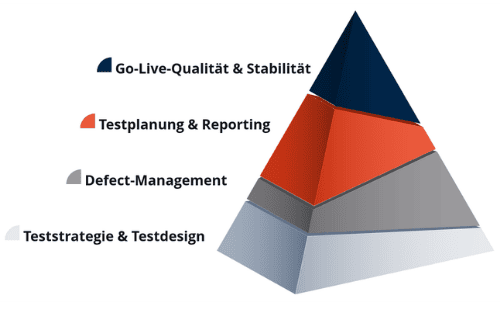
The following points are essential for successful and sustainable test management:
Test strategy
Test planning and control
Test design and test case management
Defect Management
Test reporting and quality transparency
Test documentation
Go-Live-Release logic
Use of suitable testing tools
Lessons Learned for Continuous Improvement
Test management as a service at INSIRE
At INSIRE, test management is a methodical control discipline, a technically integrated component of finance transformations, and can be used as a service across projects.
We provide support both in working with established testing tools on the customer's side and in selecting and setting up suitable tools.
We offer test management:
In SAP S/4HANA transformations
In SAP Group reporting projects
In SAP BW/4HANA & SAP Datasphere projects
In IFRS implementations
In carve-out and M&A projects
As an independent quality assurance body
Our approach, like our project management, is pragmatic rather than dogmatic.
INSIRE establishes test management as an independent portfolio element – methodically sound, structured and applicable across projects.
SAP S/4HANA transformations often have a strong process focus and/or a strong focus on data migration.
The testing requirements differ depending on the transformation approach (Greenfield, Brownfield, Selective), project scope and complexity.
This creates additional complexities:
Parallel migration
New data models
Fiori apps and authorization concepts
Interfaces to third-party systems
Ideally, a 4-system landscape is available, i.e., sandbox, development system, quality assurance system and production system.
Typical test phases in SAP S/4HANA transformations
[SBX] Exploratory Testing & Prototyping Without formal test cases
[E] Unit Tests Testing of individual customizing objects before transport to the Q system
[Q] Functional Tests / User Acceptance Tests (UAT) Across all processes, successively according to defined test cases
[Q] Cutover/migration tests Runbook run (timed simulation / dress rehearsal)
[P] Hypercare tests Without formal test cases
Depending on the project setup and complexity, different types of tests play a role in SAP S/4HANA transformations. These include functional and technical unit tests, integration tests, validation tests, authorization tests (positive/negative), regression tests, and automated testing. Validation tests, in particular, are crucial for data migrations and cutover tests, and are often prepared too late in practice.
Especially in large SAP S/4HANA transformations, test management is often the "pace-setter" just before the go-live.LiveThis is where it is decided whether the transformation will be stable and productive or end in an extended hypercare phase.
Test management in SAP Group Reporting projects
SAP Group reporting projects are highly sensitive from a technical perspective. They involve not only processes, but above all, technical and audit-compliant topics such as consolidation logic, and ultimately, consolidated financial statements and audit-relevant figures. Equally important are comprehensible test reporting and thorough test documentation, also with regard to audit-relevant requirements and the involvement of external auditors.
Possible test levels in SAP Group Reporting
The structured testing procedure includes, depending on project complexity and customer requirements:
Developer tests Technical testing of functionality
Integration tests Technical and professional tests with legacy data (Involvement of department & IT)
User Acceptance Tests (UAT) Functionality verification using real data and technical acceptance
A key success factor is the early involvement of the relevant department, especially accounting and group finance.
In contrast to purely technical tests, the focus here is on professional validation.
Test management as a strategic quality lever
Professional test management is not an optional extra expense in complex finance and SAP S/4HANA transformations. It is a strategic investment in the stability, quality, and acceptance of the entire project. Establishing structured test management early on not only reduces the risk of an unstable Go-Lives, but also creates trust among stakeholders, auditors and users.
The advantages at a glance:
Early detection of errors
Reduction of Go-Live-Risks
Transparency and controllability
Professional quality assurance
Compliance and auditability
Efficiency in the project process
Stakeholder trust
INSIRE combines methodological strength with in-depth expertise. Our test management approach is deliberately pragmatic: not an end in itself, not an overhead, but an effective management tool that brings transformations to fruition safely and sustainably. For us, this also includes transparent reporting, thorough documentation, the appropriate use of test tools, and leveraging lessons learned from project experience.