Home » Blog » Time-dependent hierarchies in SAP Datasphere: How “Hierarchy with Directory” enables historical and point-in-time analyses
Reading time: 4 minutes
Organizational structures are constantly evolving. Cost centers change departments, corporate hierarchies are restructured at the turn of the year, and product categories are renamed. For reporting that not only reflects the current status but also remains accurate retrospectively, a simple, static hierarchy is insufficient. This is precisely where one of SAP Datasphere's most interesting—and still underappreciated—capabilities comes into play: Hierarchy with Directory.
What is Hierarchy with Directory?
Since 2023, SAP DataSphere has offered its own semantic usage for parent-child hierarchies called Hierarchy with Directory. It's important to understand that this is not simply an extension of the classic hierarchy within a dimension, but rather an independent entity type – designed for the structured integration of hierarchies from SAP S/4HANA and SAP BW, such as general ledger, cost center, or profit center hierarchies, which already have their own versioning and time logic in the source system.
With Analytics & Business Intelligence, you create transparency, connect data sources and gain a sound basis for decision-making.
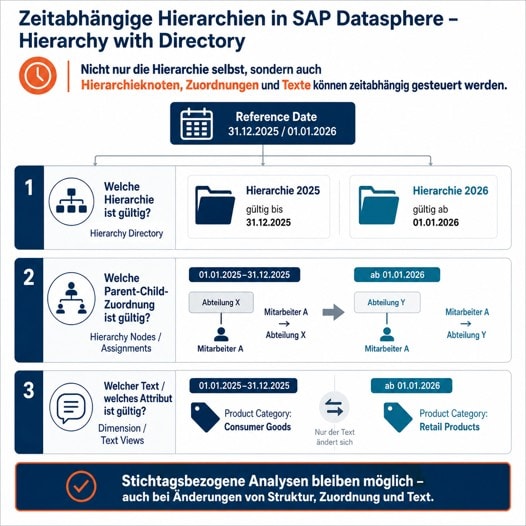
The really interesting aspect arises when one adds time dependency – on three independent levels:
1. Is the hierarchy itself valid? The Valid-From/Valid-To settings in the Hierarchy Directory allow you to define the period during which a complete hierarchy is valid. For example: Hierarchy 2025 valid until December 31, 2025, Hierarchy 2026 valid from January 1, 2026. This allows two completely different hierarchy states to exist in parallel within the system without overwriting each other.
Is the assignment valid? Individual parent-child relationships can also be defined over time. An employee belongs to department X until the end of 2025, and to department Y from 2026 onwards – thus, within the same hierarchy, the structure changes depending on the chosen cut-off date.
Is the text or attribute valid? Even product names can be time-dependent: A product category can be renamed without changing the hierarchy structure itself. The reference date determines which text valid on the respective cut-off date is displayed.
The whole thing is controlled via a Reference Date Variable In the Analytic Model: The user selects a cut-off date, and Datasphere automatically considers only the hierarchy, the assignments, and the texts valid at that time – all three levels combined.
Why this is more than just a nice-to-have
In practice, this affects every reorganization: If cost centers, sales territories, or product structures change, historical analyses must not retroactively become "incorrect." A report for Q4 2025 must reflect the structure valid at that time—even if the system is already using the structure for 2026. This is precisely what the combination of time-dependent hierarchy, time-dependent assignments, and time-dependent texts enables: analyses based on a specific date remain possible, regardless of how often the business reality has changed since then.
This is particularly valuable for scenarios where hierarchies are adopted from SAP S/4HANA or SAP BW – time dependency is often already inherent in the source system, and Hierarchy with Directory maps it structurally in Datasphere instead of simplifying it.
Conclusion
Hierarchy with Directory is more than just a technical feature for modelers. It forms the basis for ensuring that reporting and planning remain reliable even as organizational or business realities constantly evolve.